
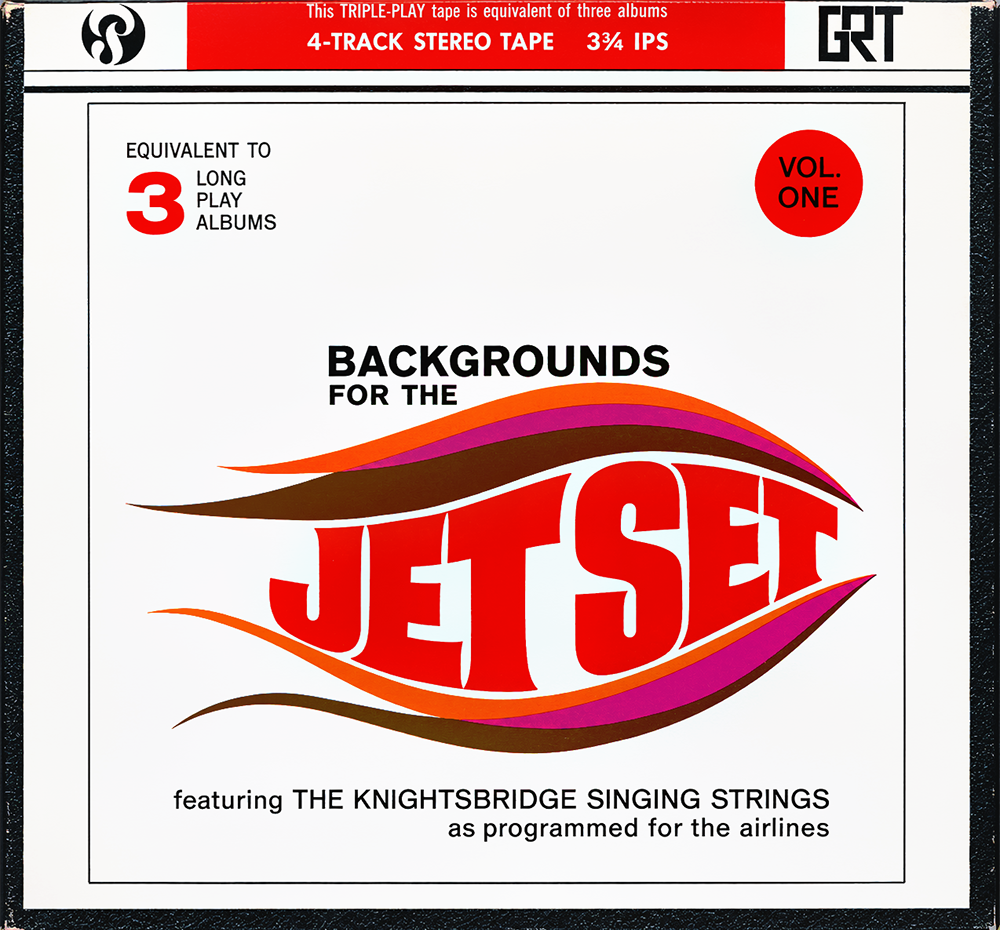
Hello, fellow audio adventurers! Finnley the Dolphin here, and today we’re taking a trip back to the 1960s with a reel-to-reel tape called Backgrounds for the Jet Set, Volume One, featuring the Knightsbridge Singing Strings on Purist Records.
This seven-inch, four-track stereo tape contains 33 instrumental selections, equivalent to three LP albums. It plays at 3¾ inches per second and was duplicated by General Recorded Tape, Inc. The packaging advertises the music as having been programmed for the airlines, which gives this recording an interesting connection to the development of in-flight entertainment.
By the mid-1960s, airlines were offering passengers prerecorded music through entertainment systems installed in their aircraft. In fact, a 1965 LIFE magazine article specifically mentions the Knightsbridge Singing Strings and Purist Records as part of TWA’s onboard music programming. So, let’s get this reel threaded up and take a look at the musicians, the recording, and how this music found its way into the skies.
The Knightsbridge Strings were a British orchestral recording ensemble whose releases appeared on Top Rank International beginning in 1959. Their catalog included albums such as The Strings Swing, The Great Waltzes, The Strings Sway, and Latin Cameos. The orchestra performed arrangements of popular standards, dance music, and light orchestral selections. The Knightsbridge name was subsequently used on recordings issued by several other labels, including Riverside, Purist, and Monument Records.
The ensemble featured on the Purist recordings was described in the October 31, 1964, issue of Billboard as consisting of 32 violins, six violas, six cellos, and two string basses, supported by rhythm, reed, and brass sections. Arrangements were credited to Malcolm Lockyer and Reg Owen, both British arrangers and conductors. The instrumentation emphasized the string section while incorporating additional instruments for different musical arrangements. The repertoire included popular songs, jazz standards, waltzes, marches, and Latin music.
Purist Records organized the Knightsbridge recordings into albums based on musical themes. Titles included Spanish Mood, Movie Mood, and other collections of popular standards arranged to suit their respective subjects. The October 1964 Billboard announcement described a ten-album series, with each release available in stereo. These recordings were also associated with airline entertainment programming, as documented the following year in LIFE magazine.
The Knightsbridge name continued to appear on recordings after the Purist releases. Later albums were issued by Monument Records, including Cinema in 1966 and Nashville in 1969. The name was also associated with recordings featuring other performers, including saxophonist Boots Randolph. Because the name appeared on recordings produced for different labels over several years, the personnel should not be assumed to have remained consistent across the entire catalog.
Backgrounds for the Jet Set, Volume One was released by Purist Records as catalog number 102. The seven-inch reel contains four-track stereo recordings at 3¾ inches per second and was marketed as a Triple-Play tape, equivalent to three LP albums. The recording contains 33 instrumental selections divided between two programs. General Recorded Tape, Inc., of Sunnyvale, California, handled the tape duplication.
The selections include “Hey There,” “My One and Only Love,” “Amapola,” “Laura,” “Over the Rainbow,” and “As Time Goes By.” Jazz and swing compositions include “Opus #1,” “One O’Clock Jump,” “Stompin’ at the Savoy,” “Take the ‘A’ Train,” and “Flying Home.” Other selections include “Bésame Mucho,” “American Patrol,” “Canadian Sunset,” and “Volga Boatmen.” The program consists primarily of popular songs and instrumental standards arranged for orchestra.
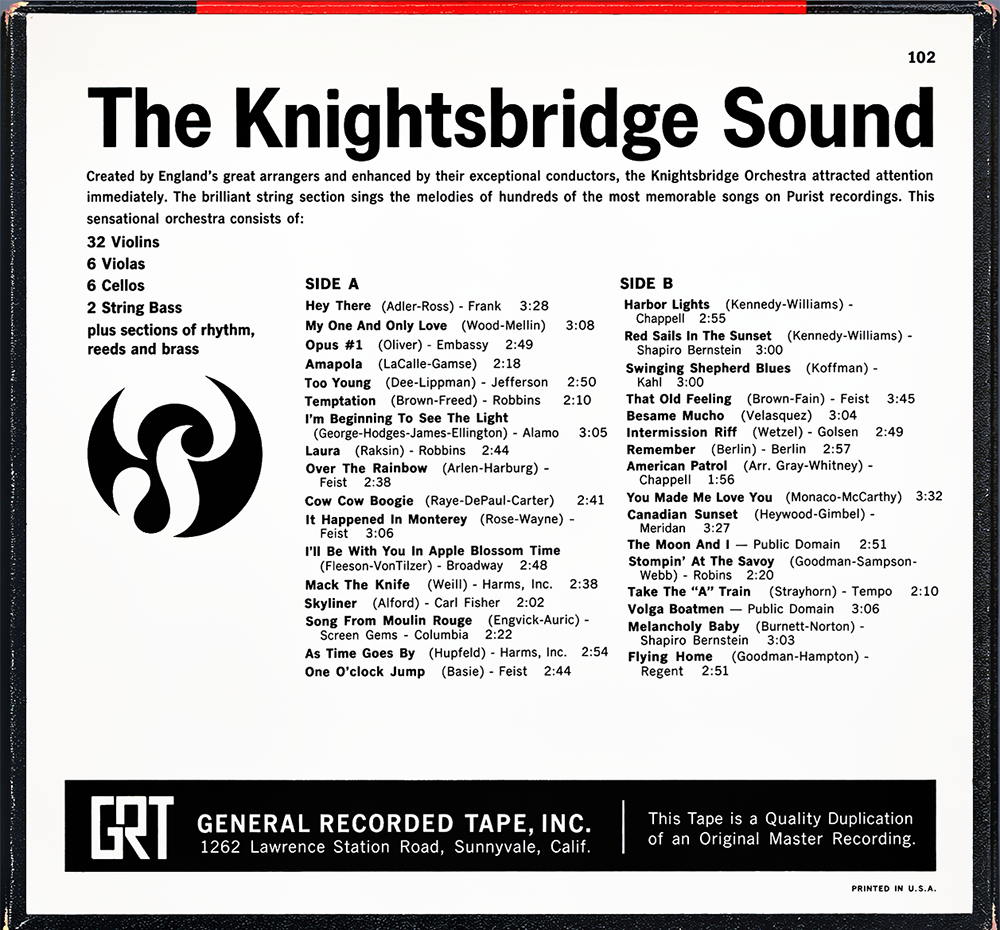
The front cover identifies the recording as music by the Knightsbridge Singing Strings “as programmed for the airlines.” It also advertises the extended playing time of the tape and identifies the recording as Volume One. The back cover, headed “The Knightsbridge Sound,” describes the orchestra’s instrumentation and provides the complete track listing with running times. The packaging also identifies General Recorded Tape as the company responsible for duplicating the original master recording.
The exact release date is not identified on the packaging or in the Discogs listing. However, Purist was promoting the Knightsbridge series in 1964, and The Harrison Tape Catalog listed Backgrounds for the Jet Set in 1966 for $9.95. The catalog identifies the recording as Purist 102, matching the number printed on the surviving tape packaging. This establishes that the recording was commercially available during the period when TWA was offering Knightsbridge Singing Strings music aboard its aircraft.
On October 29, 1965, LIFE magazine published Alan Levy’s article “The Great Escapo-Vision in the Sky,” examining the in-flight entertainment systems offered by several airlines. Levy traveled aboard different carriers to experience their movie and audio services, including TWA’s Astrovision system. His article describes the equipment, available programming, and problems encountered while using the systems. It also identifies the Knightsbridge Singing Strings as part of TWA’s recorded music programming.
During a TWA flight, Levy described using the entertainment controls at his seat. He wrote, “I plugged into Stereo 2,” identifying the classical music channel supplied by Angel Records. The system offered different recorded music programs, allowing passengers to change selections using the controls provided. Levy continued exploring the available channels during the flight (57).
Levy subsequently described switching to the channel featuring “mood music by the Knightsbridge Singing Strings on Purist Records.” This identifies both the orchestra and its American record label as part of TWA’s audio programming in 1965. The reference is consistent with the airline-related description printed on the Backgrounds for the Jet Set tape packaging. It establishes that the Knightsbridge recordings were being used in an airline entertainment system during the period in which the tape was commercially available (57).
Levy described the programming as including “six hours of continuous stereophonic fuel.” The available musical categories included classical music, jazz, Hawaiian music, marches, Spanish music, and waltzes. Several of these categories correspond to the themed recordings issued by Purist Records. His article provides an account of how passengers accessed recorded music through the aircraft’s entertainment system (57).
The controls and listening equipment were also part of Levy’s account. At one point, he wrote, “I twirled my volume knob frantically,” while describing his experience with the system. The article documents the operation of in-flight audio entertainment, including the selection of programs and adjustment of listening volume. These features allowed passengers to choose among the available channels without relying on a single program throughout the cabin (57).
Although Levy identifies the Knightsbridge Singing Strings and Purist Records, he does not mention Backgrounds for the Jet Set by title. His article therefore confirms the use of the orchestra’s recordings aboard TWA aircraft, while the commercial tape packaging establishes that the release was marketed in connection with airline programming. The sources do not establish whether this particular 33-track compilation was played aboard an aircraft in its entirety.
By the mid-1960s, airlines were offering prerecorded music through entertainment systems installed in their aircraft. Passengers could select from several audio channels using controls at their seats and listen through pneumatic headphones. TWA’s system included recordings by the Knightsbridge Singing Strings on Purist Records, as documented by Alan Levy in the October 29, 1965, issue of LIFE.
Backgrounds for the Jet Set is a commercial reel-to-reel release containing 33 selections by the Knightsbridge Singing Strings. Its packaging advertises music programmed for the airlines, connecting the release to the in-flight entertainment market. The tape was duplicated by General Recorded Tape, Inc., for playback on consumer reel-to-reel equipment.
Levy’s article confirms that TWA offered Knightsbridge Singing Strings recordings through its entertainment system. However, it does not establish that this particular tape or its complete program was used aboard an aircraft. The recording is relevant to audio history because it documents the commercial availability of music associated with early in-flight audio entertainment.
The tape also reflects how magnetic tape was used to distribute longer programs of recorded music. Its four-track stereo format operated at 3¾ inches per second and contained the equivalent of three LP albums on a single reel. Together with the contemporary Billboard and LIFE articles, the release provides documentation of the relationship between commercial recordings and airline entertainment during the 1960s.
Purist Records was a New York record label headed by Elliott Wexler, whose involvement with the Knightsbridge Singing Strings was documented in the October 31, 1964, issue of Billboard. The label issued orchestral recordings organized around musical themes, including arrangements of popular standards. Its Knightsbridge series included albums devoted to different styles and subjects, with recordings marketed for home stereo playback. The label’s catalog also supplied music associated with airline entertainment programming.
In October 1964, Billboard reported that Purist was introducing a ten-album series featuring the Knightsbridge Singing Strings. The announcement described the orchestra’s instrumentation and identified Malcolm Lockyer and Reg Owen as the arrangers. It also explained that the selections consisted of standards performed at tempos appropriate to each album’s theme. All ten albums were available in stereo.
The Knightsbridge name had previously appeared on recordings issued by Britain’s Top Rank International label. The group’s discography includes releases on Riverside Records and later Monument Records, although the available sources do not establish the complete recording history or personnel for every release. Purist’s series was one of several collections issued under the Knightsbridge name. The recordings were subsequently associated with TWA’s in-flight music programming, as documented in the 1965 LIFE article.
General Recorded Tape, Inc., duplicated Backgrounds for the Jet Set for commercial distribution. The company’s Sunnyvale, California, address appears on the back of the tape box, along with a statement identifying the recording as a duplication of an original master. The packaging identifies Purist Records as the issuing label and provides the tape’s technical specifications and track listing. The surviving release, together with contemporary magazine articles and catalog listings, documents the commercial distribution of music associated with airline entertainment during the 1960s.
Well, fellow audio adventurers, that brings us to the end of our flight! Backgrounds for the Jet Set is a reminder of a time when airlines provided prerecorded music through dedicated audio channels, and passengers listened using headphones connected to their seats. The Knightsbridge Singing Strings were among the performers heard aboard TWA flights, and this tape preserves a commercially released collection associated with that programming.
It’s interesting to think about how much in-flight entertainment has changed since then. We’ve gone from choosing between a handful of prerecorded audio channels to bringing our own smartphones and tablets aboard, connecting to the aircraft’s Wi-Fi, and watching movies, television shows, or listening to music on demand. Depending on the airline, we can even pick up right where we left off at home. All without having to wrestle with a pair of pneumatic headphones!
And with that, this dolphin is ready to collect his luggage and head for the next audio adventure. Thanks for flying along, and until next time, keep those reels spinning!
Sources:
“Purist Bows LP Series.” Billboard, 31 Oct. 1964, p. 8.
https://www.worldradiohistory.com/Archive-All-Music/Billboard/60s/1964/Billboard%201964-10-31.pdf
Levy, Alan. “The Great Escapo-Vision in the Sky.” LIFE, 29 Oct. 1965, pp. 57–58, 60, 63–64, 66. Print.
The Harrison Tape Catalog. N.p., n.p., 1966, pp. 40, 42, 49. Print.
The Knightsbridge Singing Strings. Backgrounds for the Jet Set, Volume One. Purist Records, no. 102, General Recorded Tape, n.d. Four-track stereo reel-to-reel tape. Original packaging.
“The Knightsbridge Strings.” Discogs.
https://www.discogs.com/artist/1082251-The-Knightsbridge-Strings
“The Knightbridge Singing Strings – Backgrounds for the Jet Set.” Discogs.
https://www.discogs.com/release/22919474-The-Knightbridge-Singing-Strings-Backgrounds-For-The-Jet-Set
