
Aloha, fellow wave riders. Finnley the Dolphin here, and for this Audio Adventure we’re doing something a little different. Instead of pulling an LP from the record shelf, I’m threading up a prerecorded reel-to-reel tape I recently found on eBay. This one takes us back to the late 1950s, when stereo was still new enough that record companies were trying to convince people they needed it in their living rooms. Our destination is Hawaii, or at least the version of Hawaii that Bel Canto and The Polynesians brought into the home on a seven-inch reel of magnetic tape.
The tape is Hawaiian Luau by The Polynesians, released by Bel Canto as catalog number ST/35. It runs at 7½ inches per second in two-track stereo and originally sold for $9.95, which was not an insignificant amount to spend on a single prerecorded tape in the late 1950s. The program opens with the sound of the surf at Waikiki before The Polynesians begin “Song of the Islands.” From there we get seven selections drawn from Hawaiian popular music, all presented as an early demonstration of what stereo tape could bring into the home. The music had actually existed before this particular reel, which leads us into the somewhat tangled history of Hawaiian Luau.
There is also more hiding inside this old cardboard box than I expected when I bought it. The musicians had connections with performers including Bing Crosby, the Andrews Sisters, Dorothy Lamour, and Alfred Apaka. The recording itself began life as part of a longer Crown Records album before Bel Canto repackaged it for the reel-to-reel market. Then there is Bel Canto itself, a company that was trying to sell the American public on stereo tape before stereo LPs had fully taken hold. So before I thread up the reel and let it play, let’s dive into who The Polynesians were, where this recording came from, and why Bel Canto thought magnetic tape was the future of home entertainment.
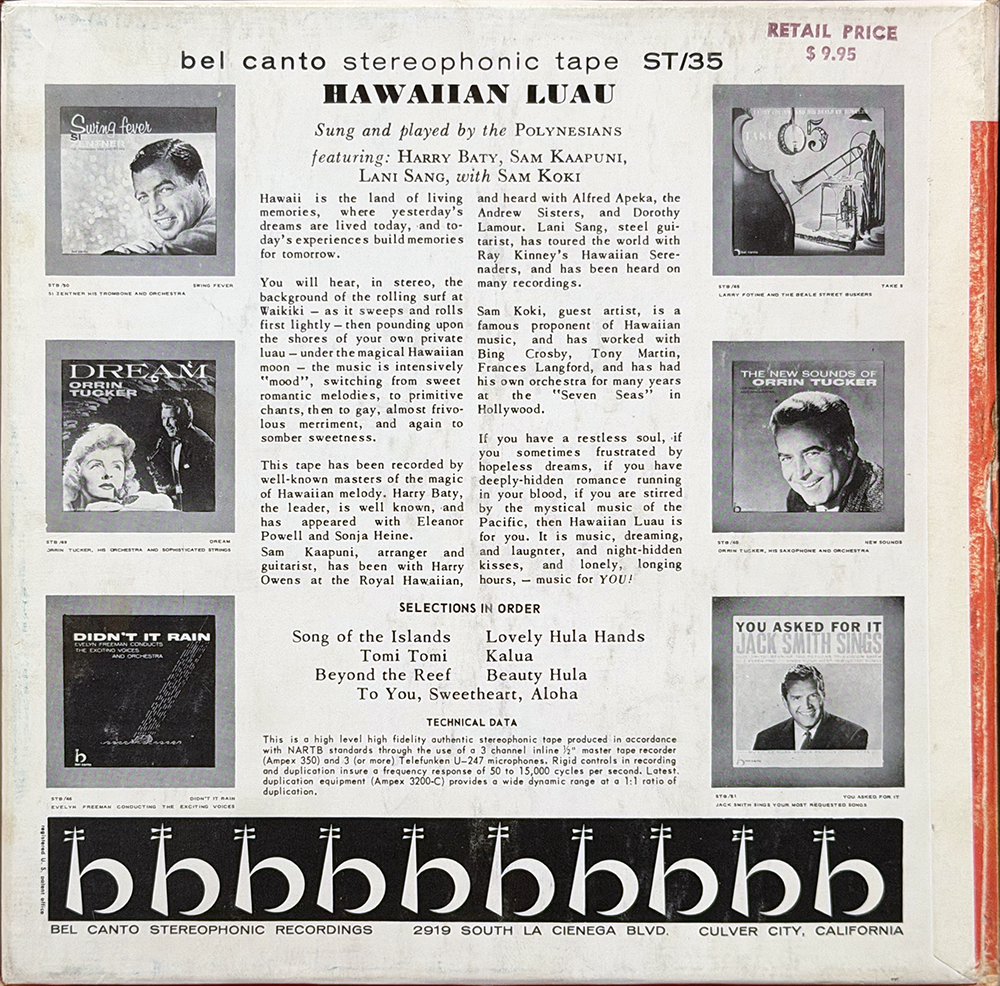
The name “The Polynesians” does not tell us much by itself, but the back of the original tape box fills in some of the blanks. It credits Harry Baty, Sam Kaapuni, Lani Sang, and Sam Koki, musicians whose careers connected them with some recognizable names in Hawaiian and American popular entertainment. That makes this more than an anonymous studio group assembled for a tape release. There were experienced musicians behind it, even if their names are not particularly familiar today. Fortunately, Bel Canto devoted a fair amount of space on the box to telling buyers who they were.
Harry Baty is identified on the box as the leader of The Polynesians and a musician who had appeared with Eleanor Powell and Sonja Henie. Sam Kaapuni was the group’s arranger and guitarist, and the notes say he had worked with Harry Owens at the Royal Hawaiian. They also connect Kaapuni with Alfred Apaka, the Andrews Sisters, and Dorothy Lamour. Lani Sang handled steel guitar and had toured with Ray Kinney’s Hawaiian Serenaders in addition to appearing on other recordings. Guest artist Sam Koki is described as a Hawaiian music performer who had worked with Bing Crosby, Tony Martin, and Frances Langford and spent years with the orchestra at the Seven Seas in Hollywood.
Those connections help place The Polynesians within the Hawaiian entertainment circuit that existed on the mainland as well as in Hawaii during the 1950s. This was a period when Hawaiian music was appearing on records from numerous labels, often alongside lounge and easy-listening releases marketed to American listeners. The original Aloha Hawaii LP appeared on Crown Records in 1957, and surviving listings identify it as a twelve-track album. The personnel information printed by Bel Canto suggests that the company wanted buyers to know these were musicians with established professional backgrounds. For me, that information makes the tape considerably more interesting because it gives some identity to the people behind music that could otherwise easily disappear into the large number of Hawaiian-themed records issued during this period.
The story gets a little more complicated when we look at what Hawaiian Luau actually is. Discogs identifies the Bel Canto tape as an abridged version of The Polynesians’ Aloha Hawaii, originally issued by Crown Records in 1957. The Crown album contained twelve tracks, while Hawaiian Luau contains only seven: “Song of the Islands,” “Tomi Tomi,” “Beyond the Reef,” “Lovely Hula Hands,” “Kalua,” “Beauty Hula,” and “To You, Sweetheart, Aloha.” The Bel Canto box confirms those seven selections and provides their intended playing order. Rather than simply duplicating the entire Crown LP on tape, Bel Canto created a shorter program for its stereo tape catalog.
My copy is Bel Canto ST/35, a two-track stereophonic recording designed to play at 7½ inches per second. The tape uses quarter-inch tape on a seven-inch reel, and the box originally carried a retail price of $9.95. Bel Canto’s technical notes say the recording was made according to NARTB standards using a three-channel, half-inch master tape recorder, identified as an Ampex 350, with three or more Telefunken U-47 microphones. The company also claimed a frequency response of 50 to 15,000 cycles per second and said duplication was performed on Ampex 3200-C equipment at a 1:1 ratio. These specifications were printed directly on the package, making the technical side of the recording part of the way Bel Canto sold the tape. My own anaylsys confirms this with a spetrum scan showing a 50hz to 18Khz response.
There is another feature of the recording that Bel Canto clearly wanted listeners to notice. The tape opens with the sound of the rolling surf at Waikiki before moving into “Song of the Islands,” an effect specifically mentioned on the box. Billboard noticed it too when it reviewed Hawaiian Luau in its January 20, 1958 issue, describing the opening surf effect as one of the more impressive aspects of the tape. The review was less enthusiastic about the remainder, saying the familiar tunes were performed well enough and were well recorded but were “not inspired.” That gives us an interesting contemporary counterpoint to Bel Canto’s much more enthusiastic promotional copy. More than six decades later, the opening is also a reminder that early stereo recordings frequently used environmental sounds and other effects to demonstrate what the new format could do.
The seven songs themselves draw heavily from Hawaiian standards that would have been familiar to listeners buying this sort of recording in the late 1950s. “Beyond the Reef” and “To You, Sweetheart, Aloha” were already established songs by the time this tape appeared, while titles such as “Lovely Hula Hands” fit directly into the popular Hawaiian repertoire of the period. The sequence moves between vocal and instrumental performances, with steel guitar playing an important role in establishing the sound of the group. Bel Canto’s own notes describe the program as shifting from romantic melodies to chants before returning to slower material. Strip away the sales language on the box and what remains is a compact sampler of the kind of Hawaiian popular music being marketed to mainland listeners during the late 1950s.
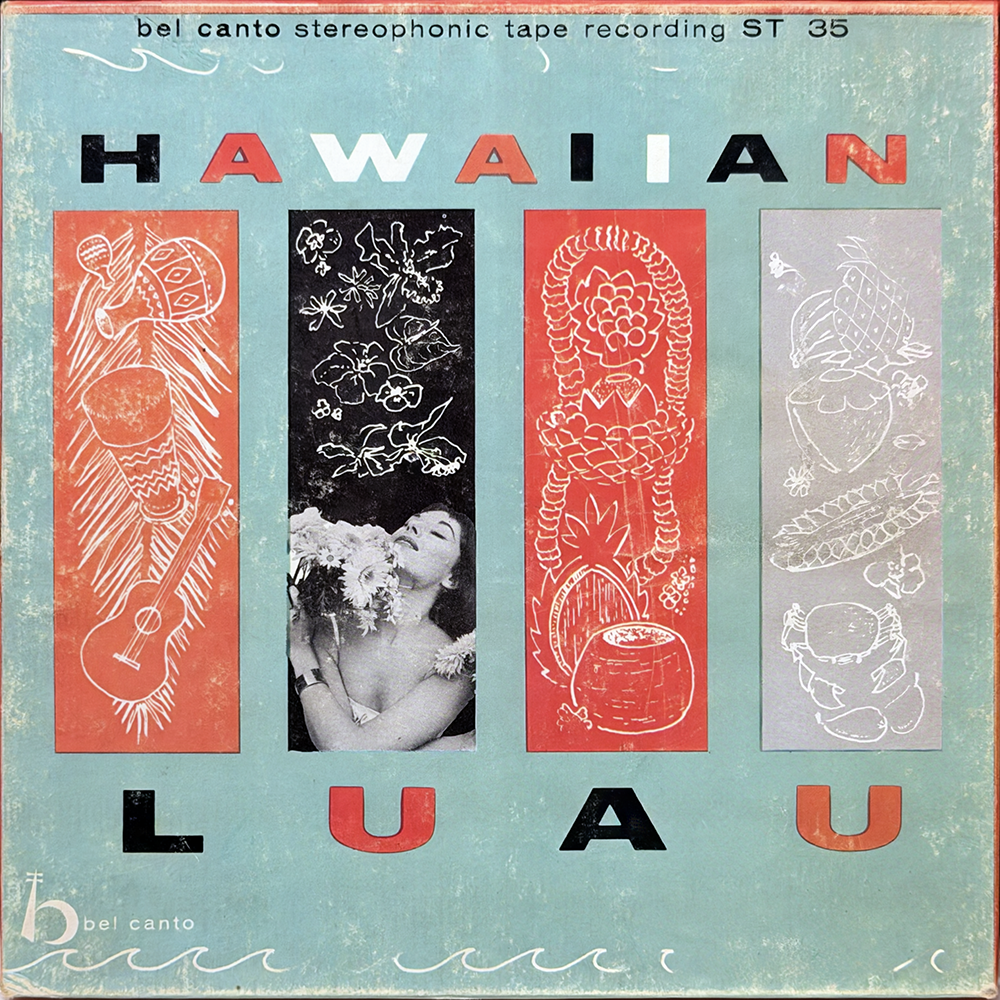
The physical tape also tells part of the story. The front of the box uses a turquoise background with illustrated panels showing Hawaiian imagery and a photograph of a woman wearing a lei, while “HAWAIIAN LUAU” is spread across the cover in alternating colors. The back devotes a surprising amount of space to advertising other Bel Canto releases alongside the notes for Hawaiian Luau. Albums by Si Zentner, Orrin Tucker, Evelyn Freeman, and Jack Smith appear around the program notes, turning the package into a small catalog for other tapes a customer might buy. Even the $9.95 retail price is stamped prominently near the top. This was packaging designed not only to identify the recording but also to sell the listener on Bel Canto’s larger stereo tape catalog.
Bel Canto is probably the part of this tape’s history that interests me the most. According to the label history preserved by Discogs, Russ Molloy started the company in 1955 as the Bel Canto Magnetic Tape Co., and its first tape was released in November of that year. The company operated at 2919 South La Cienega Boulevard in Culver City, California, an address printed prominently across the bottom of my Hawaiian Luau box. Bel Canto was entering the prerecorded tape business while stereo was still finding its way into American homes. A tape like ST/35 therefore represents not only a music release but also a piece of the early consumer stereo market.
Bel Canto was actively trying to convince consumers that stereo tape was worth buying. In October 1957, the company started a television program called Stereohour on KABV in Los Angeles, with the stated goal of exposing the public to the new experience of stereo and encouraging sales of tapes and tape recorders. By May 1958, Bel Canto had entered the stereo LP market as well and adjusted the pricing of its stereo tapes to make them more competitive with records. That timing places Hawaiian Luau right in the middle of a period when the company was experimenting with how stereo music should be sold. The format was changing quickly, and Bel Canto was trying several ways of getting stereo recordings into consumers’ homes.
A full-page Bel Canto advertisement in the May 16, 1960 issue of Billboard gives a good idea of how the company saw itself a few years later. Under the headline “No dog days with BEL CANTO tapes!” the company told retailers that its tapes were already strong sellers in electronics stores and photographic supply shops. The advertisement listed Louis Armstrong, Patti Page, Danny Kaye, Martin Denny, Julie London, Billy Vaughn, Jack Smith, and the London Philharmonic among artists represented in its catalog. Bel Canto also advertised releases on two-track and four-track reel-to-reel tape as well as cartridges. At the bottom was the slogan, “The future of home entertainment is magnetic tape,” which says quite a bit about where the company believed the market was heading.
Hawaiian Luau appears to have remained available for several years after its initial release. The Harrison Tape Guide, published by Weiss Publishing Corporation in 1962, still lists the title under The Polynesians. The guide includes Bel Canto versions of the recording among its Hawaiian music listings, showing that the title remained in circulation while prerecorded tape formats were changing. By then, four-track stereo tape had become increasingly important, while the earlier two-track configuration represented by my ST/35 copy was becoming an older format. Seeing the same title appear in a 1962 tape guide helps trace its life beyond the original late-1950s release.
There is one last piece of the Bel Canto story that I find interesting because it still exists. The address printed across the bottom of the box, 2919 South La Cienega Boulevard, can still be found on Google Street View. The current building gives little indication that prerecorded stereo tapes once came from this address, and the surrounding area has naturally changed since the 1950s. Yet the building gives a physical location to a company that otherwise survives mostly through old tapes, advertisements, catalogs, and equipment guides. Holding this copy of Hawaiian Luau while looking at that address today closes a small gap between the object and the people who manufactured it.
After spending some time with Hawaiian Luau, I think the tape itself tells a story that goes beyond the seven songs recorded on it. It comes from a brief period when prerecorded reel-to-reel tape was being sold as a serious home music format and stereo was still something manufacturers needed to demonstrate to people. Bel Canto even printed information about the recording and duplication equipment on the box because those details mattered to the customer they were trying to reach. Today we usually do not need to know what equipment was used to duplicate an album before deciding whether to listen to it. In the late 1950s, that information helped sell the technology along with the music.
There is also something satisfying about being able to trace this particular reel through several pieces of surviving history. We have the original Crown album, the Bel Canto tape box, a contemporary Billboard review, Bel Canto advertising, and a listing that was still appearing in The Harrison Tape Guide in 1962. We can even look up the address printed on the box and see the building at 2919 South La Cienega Boulevard today. None of those pieces tells the entire story on its own. Put them together, though, and this old reel starts to have a history beyond simply being something I happened to find on eBay.
And now there is one more chapter in that history because this copy is spinning again. Someone bought it when prerecorded stereo tape was still relatively new, someone kept it long enough for it to survive into the twenty-first century, and eventually it found its way here to Finnley’s Audio Adventures. That is one of the reasons I enjoy digging into old recordings like this. Sometimes what looks like an ordinary box sitting on a shelf turns out to be a small piece of recording history. Until the next reel, record, or other forgotten bit of audio washes ashore, this is Finnley the Dolphin signing off from another Audio Adventure.
Sources used:
Bel Canto. “Bel Canto.” Discogs. Accessed 19 Sept. 2026.
https://www.discogs.com/label/97594-Bel-Canto
Bel Canto Stereophonic Recordings. “No Dog Days with BEL CANTO Tapes!” Advertisement. Billboard, 16 May 1960, p. 20.
Google. “2919 S. La Cienega Blvd., Culver City, California.” Google Maps, Street View, July 2025. Accessed 19 Sept. 2026.
https://www.google.com/maps/@34.0320567,-118.3737382,3a,75y,204.4h,94.18t/data=!3m7!1e1!3m5!1sbDo2ZOl9-02aQm70vePAUA!2e0!6shttps:%2F%2Fstreetviewpixels-pa.googleapis.com%2Fv1%2Fthumbnail%3Fcb_client%3Dmaps_sv.tactile%26w%3D900%26h%3D600%26pitch%3D-4.178783300322408%26panoid%3DbDo2ZOl9-02aQm70vePAUA%26yaw%3D204.39775689099912!7i16384!8i8192?entry=ttu&g_ep=EgoyMDI2MDkxNi4wIKXMDSoASAFQAw%3D%3D
“Hawaiian Luau.” Billboard, 20 Jan. 1958, p. 45.
Hawaiian Luau. Performed by The Polynesians, Bel Canto Stereophonic Recordings, ST/35, prerecorded stereophonic reel-to-reel tape. Author’s collection.
The Polynesians. Hawaiian Luau. Discogs. Accessed 19 Sept. 2026.
https://www.discogs.com/release/24452240-The-Polynesians-Hawaiian-Luau
The Harrison Tape Guide. Weiss Publishing Corporation, 1962, pp. 35, 38.
