
Hello, my deep-sea listeners, and welcome back to another dive into the currents of recorded sound. Today, we are not just dropping the needle on a record, we are stepping into a moment when music itself was being reshaped by technology. The late 1950s brought a shift from flat, single-channel recordings into something with depth and movement, where instruments could travel across the room in ways that felt new at the time. That change arrived with new recording methods, careful engineering, and artists willing to experiment with how sound could be arranged. It was a period where the medium and the music were evolving together.
One such traveler of these sonic waters was Dick Schory, a musician who placed percussion at the center of his work. Where others treated it as support, he used it as structure. Where others stayed within familiar instrumentation, he expanded the palette to include objects chosen for their sound rather than their tradition. When stereo recording created new space, he filled it with arrangements designed to move across that space. His work reflects a direct response to the capabilities of the recording process.
At the center of this exploration sits Music For Bang Baa-Room And Harp, a record that presents its ideas without hesitation. It introduces motion, contrast, and a wide range of percussion from the start. This post follows that record from the broader context of RCA Victor’s Living Stereo era, through Schory’s background, and into the structure of the album itself. Settle in, keep your stylus steady, and let’s ride the groove current together.
RCA Victor introduced its Living Stereo series during a period when recorded sound was undergoing a major shift. In the early 1950s, most commercial recordings were still issued in monaural format, meaning all sound came from a single channel. Engineers began experimenting with multiple microphones to create a sense of space, placing listeners within the performance rather than in front of it. Early sessions in New York explored this idea using two-channel recording, sometimes referred to as binaural sound. These experiments led to a gradual transition toward commercial stereo releases later in the decade. By 1958, stereo LPs were entering the consumer market with a new visual identity and technical promise.
The technical process behind Living Stereo recordings evolved alongside improvements in tape machines and studio practices. Early recordings used two-track tape, capturing left and right channels separately, which allowed for basic spatial placement of instruments. Within a few years, engineers adopted three-track recording, adding a center channel that improved balance and flexibility during mixing. These recordings were later reduced to two channels for vinyl release, preserving spatial cues while maintaining compatibility with home equipment. Microphone placement became a central concern, with engineers adjusting positions to capture both clarity and room acoustics. This method relied on careful planning rather than heavy post-processing, which shaped the sound that listeners heard at home.
Recording spaces also played a key role in defining the Living Stereo sound. Venues such as concert halls and large studios were chosen for their acoustic qualities, allowing natural reverberation to become part of the recording. Instead of isolating each instrument, engineers captured ensembles as they would sound in a shared space. This approach required musicians to remain in fixed positions so that stereo imaging remained consistent. It also meant that the performance itself had to be precise, since editing options were limited compared to later digital methods. The result was a recording style that emphasized realism and spatial depth without relying on artificial effects.
The Living Stereo series was marketed as both a technical advancement and a listening experience. Album covers often highlighted the stereo format as a defining feature, encouraging buyers to explore the capabilities of their equipment. These records were not only musical releases but also demonstrations of what stereo sound could achieve. Consumers were invited to listen for movement across channels and the placement of instruments within a virtual space. This emphasis on listening technique helped shape how audiences engaged with recorded music during the late 1950s and early 1960s. The format became associated with high fidelity systems and careful listening at home.
Over time, Living Stereo recordings gained a reputation among collectors and engineers for their sound quality. Many of these recordings have been reissued in later formats, including reel-to-reel, compact disc, and high-resolution digital releases. The original tapes have often been preserved, allowing modern engineers to revisit the material using updated equipment. Despite changes in technology, the core approach of capturing sound in a natural acoustic environment remains a reference point. These recordings continue to be studied for their balance between technical precision and musical presentation. The Living Stereo label has since become a recognizable marker of this specific era in recording history.
The development of stereo recording did not exist in isolation. It required musicians who were willing to adapt their performance style to match new recording methods. It also relied on individuals who understood both the artistic and technical sides of music production. Among those figures, Dick Schory stands out as someone who used these tools in a direct and intentional way. His work reflects how stereo recording could influence not just how music was captured, but how it was written and performed. To understand the record itself, it is necessary to look at the person behind it.
Dick Schory built his career at a time when percussion was still often treated as a supporting element rather than a central focus. He was trained in classical percussion and performed with local ensembles before expanding into broader musical settings. His early work included participation in orchestras as well as writing for radio and television. This combination of performance and composition gave him experience in both structured and commercial environments. He developed an understanding of how percussion could function in different contexts, from concert halls to studio recordings. This background shaped the direction of his later projects.
During his time at Northwestern University, Schory organized a percussion ensemble that emphasized original compositions and arrangements. At that time, there was limited published material for percussion groups, so much of the repertoire had to be created by the performers themselves. This environment encouraged experimentation with instrumentation and structure. The ensemble became a foundation for what would later develop into his professional recording projects. It also introduced the idea that percussion could carry melodic and harmonic roles, not just rhythmic support. This concept would remain central to his work.
Schory also played a significant role in the development of percussion as an educational and commercial field. His work with the Ludwig Drum Company placed him in a position to influence both product design and teaching methods. He promoted the idea of “total percussion,” which included a wide range of instruments beyond the traditional drum set. This approach encouraged students and educators to consider mallet instruments, auxiliary percussion, and orchestral elements as part of a unified system. He also contributed to the creation of beginner kits that introduced students to multiple aspects of percussion at once. These efforts helped expand the market for percussion instruments and materials.
In addition to his educational work, Schory maintained an active recording and performing career. His Percussion Pops Orchestra combined elements of big band arrangements with expanded percussion sections. The group toured widely and presented concerts that emphasized spatial sound, often arranging instruments across the stage to reflect stereo placement. This mirrored the techniques used in his recordings, creating a connection between live and recorded performances. He also worked with other musicians and ensembles, contributing to both studio sessions and orchestral projects. His ability to move between different musical settings allowed him to reach a wide audience.
Later in his career, Schory continued to explore new recording formats and production methods. He founded Ovation Records and became involved in developments such as quadraphonic sound. His work extended beyond performance into production and business operations, reflecting his broader interest in how music was created and distributed. He produced many recordings across different genres and formats. His influence can be seen in both the growth of percussion ensembles and the way percussion is used in recorded music. His career reflects a consistent effort to expand the role of percussion in modern music.
Schory’s background in performance, education, and recording provided the framework for his work in the studio. His interest in stereo sound and expanded instrumentation came together in a series of recordings that were designed with those ideas in mind. These records were not assembled by accident. They were planned to demonstrate how percussion could function within a stereo environment. One of the clearest examples of this approach is found in a single release from 1958. That record brings together the technical context of Living Stereo and Schory’s approach to percussion.
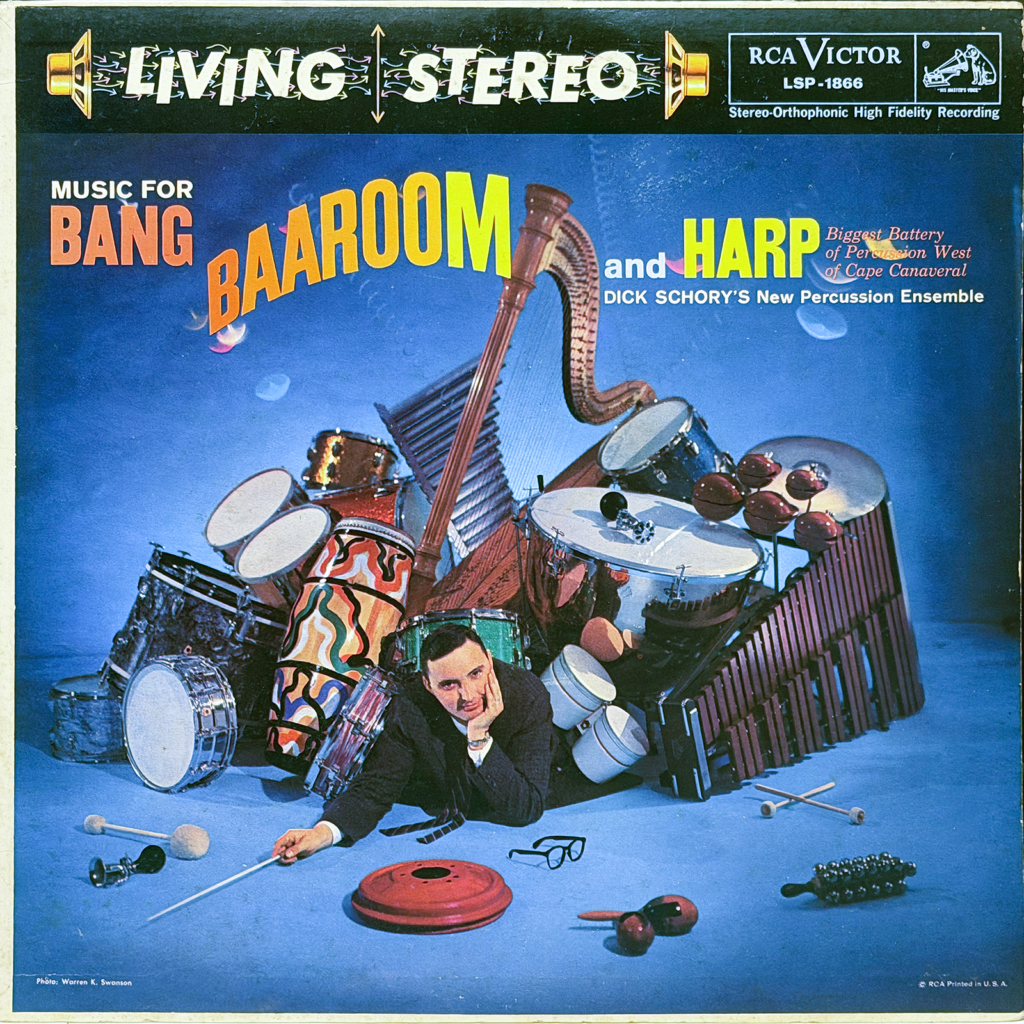
Music For Bang Baa-Room And Harp was released in 1958 on RCA Victor as part of the Living Stereo series. The album was recorded at Orchestra Hall in Chicago, using techniques that emphasized spatial sound and instrument placement. It features Schory’s New Percussion Ensemble, a group built around the idea of expanding percussion beyond its usual role. The title itself reflects the nature of the project and signals that the listener should expect something outside standard arrangements. From its presentation to its content, the record was designed to highlight the possibilities of stereo recording. It fits within the broader trend of hi-fi demonstration albums from the late 1950s.
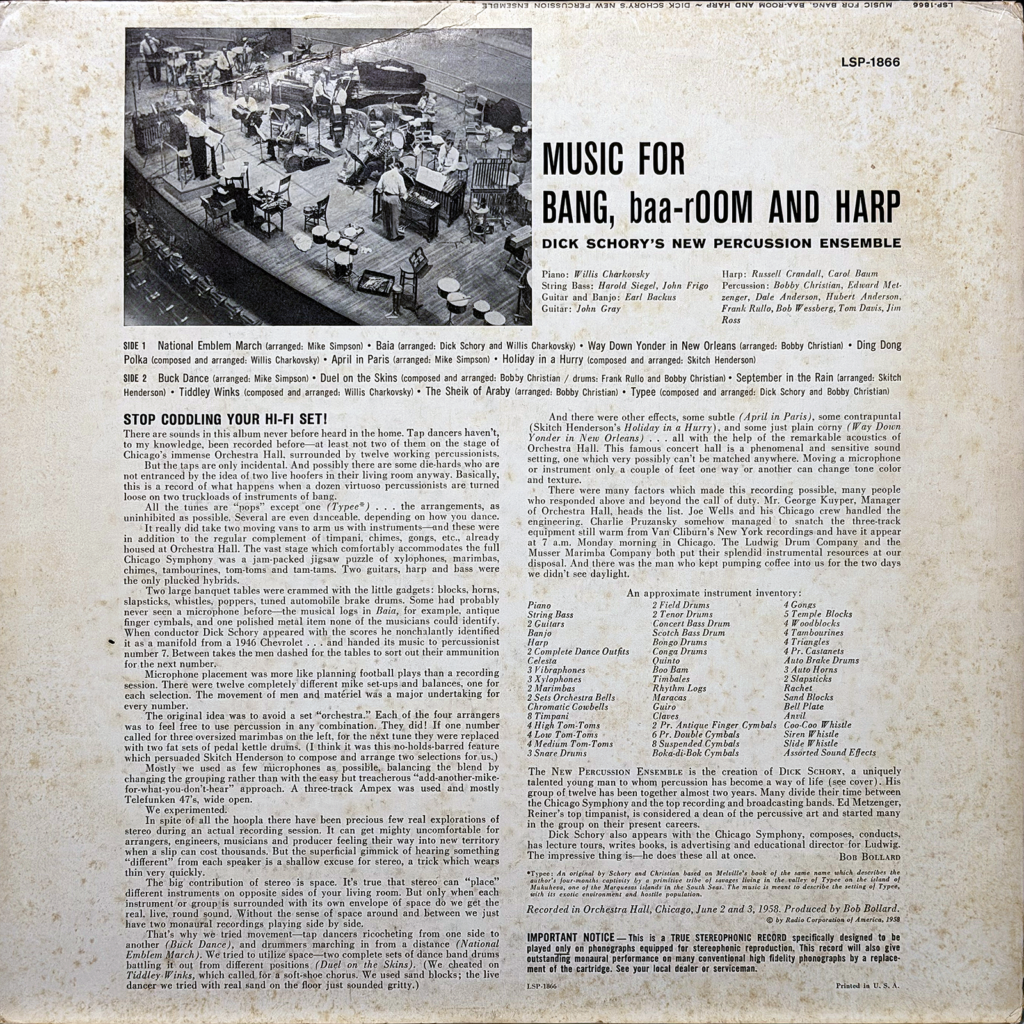
The instrumentation on the album is extensive and includes both conventional and unconventional percussion. Standard instruments such as drums, vibraphones, and marimbas are combined with objects not typically associated with music. These include items chosen for their tonal qualities rather than their traditional use. The goal was to create a wide range of sounds that could be placed across the stereo field. This approach required careful arrangement and coordination among the performers. Each track uses the available instruments in different ways, contributing to the overall structure of the album.
Recording techniques played a central role in shaping the sound of the album. Multiple microphone setups were used, often tailored to individual tracks rather than applied uniformly. Engineers and musicians worked together to determine how each instrument would be positioned within the stereo image. Movement across channels was sometimes incorporated as part of the arrangement, creating a sense of motion within the recording. This required precise timing and coordination during performance. The use of three-track recording allowed for additional control during mixing, though the final release was presented in two-channel stereo.
The album’s repertoire includes a mix of original pieces and arranged standards. Tracks such as “National Emblem March” and “April in Paris” are reinterpreted through the lens of percussion-focused arrangements. Other pieces emphasize rhythmic patterns and tonal variation rather than melody in the traditional sense. This balance between familiar material and experimental approach makes the album accessible while still exploring new territory. The sequencing of tracks also reflects an effort to maintain listener attention through contrast and pacing. Each side of the record presents a range of textures and approaches.
The presentation of the album extends beyond the music itself. The cover art shows Schory surrounded by a large collection of percussion instruments, reinforcing the concept of scale and variety. The liner notes describe the recording process and encourage listeners to engage with the stereo effects. This framing positions the album as both a musical work and a demonstration of recording technology. It remained on the Billboard charts for an extended period, indicating a level of commercial success. Over time, it has come to represent a specific moment in the development of stereo recording and percussion-based music.
By the time the final notes of Music For Bang Baa-Room And Harp fade back into the quiet of the room, it becomes clear that this record was never meant to sit still. It belongs to a moment when recording technology and musical ideas were moving forward at the same time. The Living Stereo process gave artists space to experiment, but it still required someone to use that space with intent. Schory approached that opportunity with a clear direction, building arrangements that depended on movement and placement as much as melody.
Looking back, the record stands as a document of how those ideas were tested in real time. The techniques used during its production were not hidden behind later editing tools. They were part of the performance itself. Musicians had to stay in place, microphones had to be set with purpose. Every sound captured had its position within the stereo field. This connection between performance and recording gives the album a sense of presence that remains noticeable even now.
For those exploring the edges of mid-century sound, this album offers a clear path into that world. It shows how percussion can carry an entire arrangement, how stereo can shape the listener’s experience, and how a record can function as both music and demonstration. It does not require special framing to be understood, only attention to what is happening across the channels. And as always, keep your stylus clean, your records dry, and your ears tuned to the currents still moving beneath these grooves.
Sources:
Biro, Nick. “Kick Off NARAS Midwest Chapter Drive at Meet.” Billboard, 12 Dec. 1960, p. 10.
Hopper, David. “Witches’ Brew and the Legacy of RCA Living Stereo.” 360 Degree Sound, 4 Nov. 2020, https://360degreesound.com/witches-brew-and-the-legacy-of-rca-living-stereo/.
Lee, William F. American Big Bands. Bloomsbury Academic, 2005, pp. 334–335.
Ludwig, William F. II. The Making of a Drum Company: The Autobiography of William F. Ludwig II. Rebeats Publications, 2001, pp. 58–60.
“Dick Schory.” Discogs, https://www.discogs.com/artist/423099-Dick-Schory.
“Dick Schory – Music For Bang Baa-Room And Harp.” Discogs, https://www.discogs.com/release/36084676-Dick-Schory-Music-For-Bang-baa-room-And-Harp.
“Dick Schory.” Percussive Arts Society, https://pas.org/dick-schory/.
“Dick Schory.” Space Age Pop Music, https://www.spaceagepop.com/schory.htm.
“RCA Records.” Wikipedia, https://en.wikipedia.org/wiki/RCA_Records.
Hi Fi/Stereo Review. Ziff-Davis Publishing Company, 1961, p. 93.
Eychaner v. Gross. Supreme Court of Illinois, 2001, p. A42.
